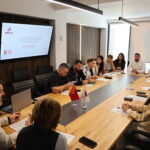
In cooperation with Resilience Center in Lezha, it was held the next informative session with the participation of girls, women, boys and men from vulnerable target groups, mainly from families with socio-economic problems, Roma and Egyptian community, parents of children with dissability, as well as young activists who have been engaged throughout the project, related to gender-based violence and domestic violence.
During the information session, some of the visible and hidden forms of violence were discussed and analyzed, factors that contribute to the precipitation of gender-based violence in the local community, concrete forms of reporting, as well as social and legal services provided in Lezha.
A special importance, in addition to the discussion on the most frequent factors inciting violence such as economic impossibility or the use of alcohol, was also placed on the factors that influence the non-reporting or non-solving of the problem. The mentality of the community, or the culture of acceptance of violence or its "light" forms, were considered as among the key favorable factors. "We live in a society where the priority is not the individual, but the honor of the family. The family often asks the woman to endure the violence, just for the sake of not being divorced or not being gossiped about the fact that "the husband left her" - said one of the attendees. The impossibility of reporting due to these factors, causes the cycle of violence to repeat itself endlessly until it reaches serious consequences for the victim, which reach suicide or imprisonment for the reason of murdering the perpetrator.
On the other hand, some of those present emphasized that even in cases where the violence is identified and the perpetrator is reported, the solution remains to the victim leaving and "closing of the case" within the family environment, while no action is taken against the perpetrator. There are frequent cases when the victim is not informed, does not even have the support of the family or law-enforcement institutions because the perpetrator has internal connections within this institutions, thus favoring the cycle of violation of rights for protection.
This activity was carried in framework of "Improving Community Resilience (ICR)" program, financed by USAID and implemented by UNDP Albania, in partnership with Kurbin and Lezha Municipalities and Together for Life Association.